
How Do Torsion Springs Improve Garage Door Energy Efficiency?
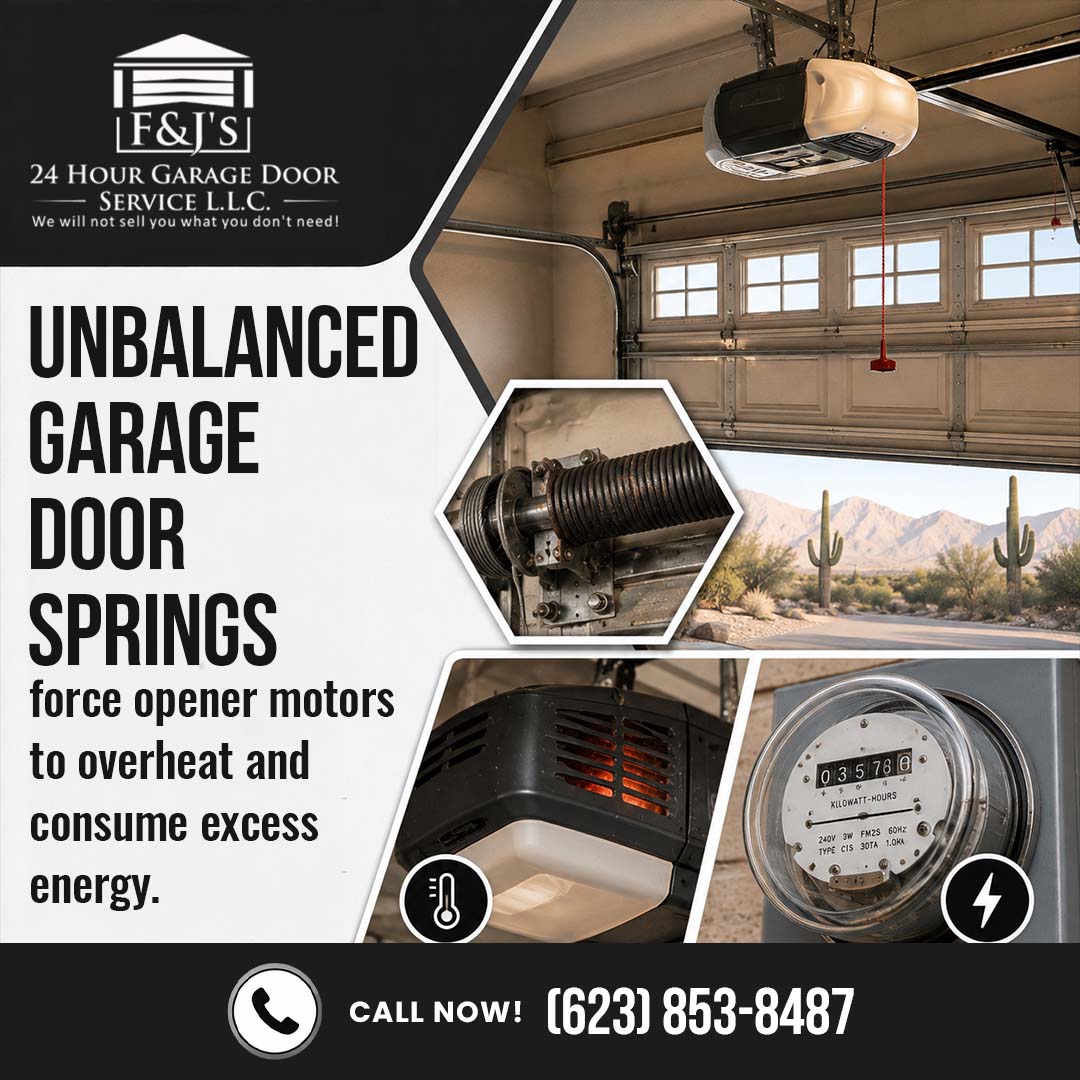
A garage door torsion spring stores energy as it twists, then releases that energy to lift most of the door’s weight. The opener motor only has to guide the door and control its speed, instead of hauling the full load alone. A properly tensioned garage door spring lowers the motor’s power draw, reduces heat and wear, and helps the opener last longer. At F&J’s 24 Hour Garage Door Service, we see this firsthand in homes across the Valley.
How Does a Torsion Spring Reduce the Opener’s Power Draw?
A garage door torsion spring winds tight on a shaft above the door as it closes, storing mechanical energy. As the opener lifts the door, the spring unwinds and releases that stored energy into the lift, so the motor handles only a small fraction of the door’s actual weight.
Electric motors are built to run most efficiently within a specific rated load range, and pushing a motor beyond that range raises its operating temperature. According to Plant Engineering, every 10°C rise in a motor’s operating temperature can cut the expected life of its winding in half. A garage door opener follows the same rule. When the spring is doing its share, the motor stays cooler and inside its efficient range on every cycle.
What Happens When a Spring Wears Down?
A worn or unbalanced spring shifts more of the lifting load onto the motor, pushing it outside that efficient range. The motor draws more current to compensate, runs hotter, and wears out sooner than it should. This is one of the most common reasons openers fail years early, and it’s why our technicians at F&J’s 24 Hour Garage Door Service treat a garage door spring repair, not a new opener, as the real fix.
Torsion Springs vs. Extension Springs
| Factor | Torsion Spring | Extension Spring |
| Load distribution | Even, across one shaft | Split between two side springs |
| Motor power draw | Lower and steadier | Higher as springs stretch |
| Typical cycle life | 15,000-20,000 cycles | 5,000-10,000 cycles |
| Balance precision | Fine-tuned to door weight | Harder to balance evenly |
Why Local Heat Adds to the Load
Phoenix recorded 143 days with high temperatures at or above 100°F in 2024, according to the National Weather Service. That kind of repeated heat cycling stresses the coils of a garage door torsion spring, and homes in Prescott Valley see their own version of this wear from wide swings between hot days and cool desert nights. Springs under that kind of repeated stress lose tension faster, so the opener quietly starts working harder before anyone notices.
Signs Your Spring Is Costing You Energy
- The opener strains, grinds, or labors partway through a cycle.
- The door feels heavy when lifted by hand with the opener disconnected.
- The opener reverses unexpectedly or runs longer than usual.
- You’ve needed more than one garage door spring repair in the same year.
- The door drops faster on the way down than it used to.
Two or more of these usually mean a garage door spring replacement in Phoenix will cost less over time than repeated repairs or a replacement opener.
Frequently Asked Questions
- Does a weak spring affect my electric bill?
Yes. A motor pulling extra current on every cycle adds up over a year, even if the difference on a single cycle is small.
- Can I check my spring’s balance myself?
Disconnect the opener and lift the door halfway by hand. If it doesn’t stay in place, the spring needs professional attention.
- How long does a torsion spring last in Arizona’s heat?
It depends on cycle count and climate exposure, so springs here often wear faster than the same spring in a milder region.
Keep Your Opener Running the Way It Was Designed To
A torsion spring doing its job means your opener isn’t doing work it was never built for. If your door feels heavy or your opener sounds strained, F&J’s 24 Hour Garage Door Service can check the spring and balance in one visit, whether you’re in Phoenix or Prescott Valley. Call us at (623) 853-8487 or email jsanchez@fnjsgarage.com to schedule.
