
What Happens to a Garage Door’s Seal When the Spring Wears Out?
A worn garage door spring lets the door sag or hang unevenly instead of sitting flat in its frame. That unevenness pulls the weatherstripping away from the frame on one or more sides, creating small gaps where air moves in and out. The longer a weak spring goes unaddressed, the wider those gaps tend to get. At F&J’s 24 Hour Garage Door Service, we check the seal every time we inspect a spring, since the two problems usually appear together.
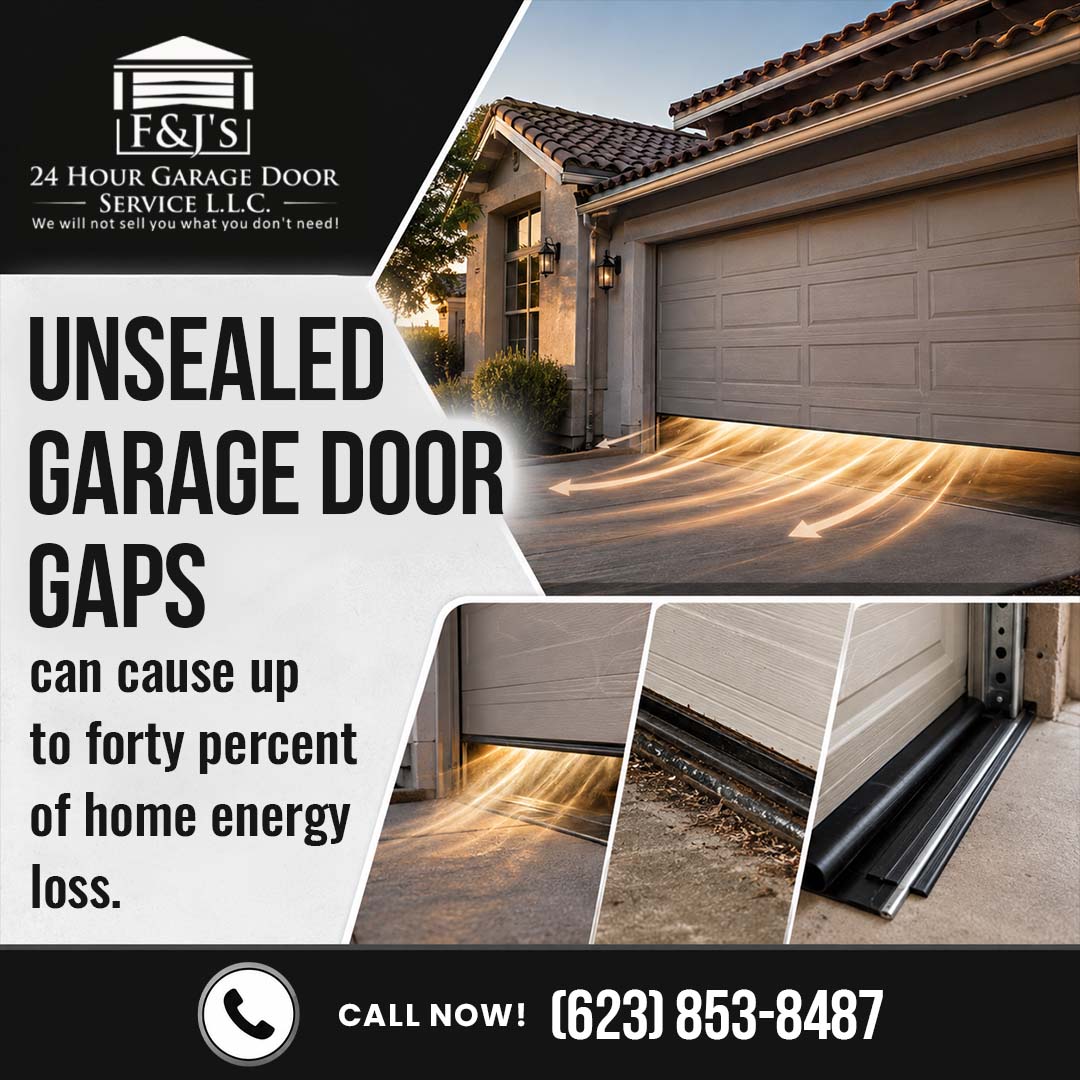
How Does Spring Wear Throw Off the Door’s Seal?
A garage door torsion spring counterbalances the door so it can close flush and level against the frame. As the spring loses tension, it can no longer support the door evenly across its width. One side may drop slightly faster than the other, or the whole door may settle lower than it should.
That small shift changes how the weatherstripping meets the frame. Rubber seals are only effective when compressed evenly along their full length. A door that closes even a little off-level leaves part of that seal loose, and a loose seal does not block air the way a compressed one does.
Why Do Small Gaps Around a Garage Door Matter?
Air leakage accounts for a large share of a home’s heating and cooling losses. According to an ENERGY STAR fact sheet, air leakage is responsible for 25% to 40% of the energy used for heating and cooling a typical home. A garage door gap does not need to be large to contribute to that number, especially in an attached garage next to living space.
Sealing those leaks pays off in a measurable way. The U.S. Environmental Protection Agency estimates that homeowners can save up to 10% on their annual energy bill simply by sealing air leaks and adding insulation.
Balanced Door vs. Unbalanced Door: Seal Comparison
| Factor | Balanced Door | Unbalanced Door |
| Weatherstrip contact | Even compression on all sides | Gaps along one or more edges |
| Air movement | Minimal | Draft points at edges and bottom |
| Wear pattern | Uniform seal wear over time | Seal compresses unevenly, wears faster on one side |
| Visible sign | Door sits flush when closed | Door tilts or leaves a visible line of light |
Does Local Climate Make Seal Problems Worse?
Homes in Phoenix and Prescott Valley see wide day-to-night and seasonal temperature swings. That constant expansion and contraction affects both the garage door torsion spring and the rubber weatherstripping, so a spring that’s already losing tension tends to widen an existing gap faster than it would in a milder, steadier climate.
Signs Your Garage Door Seal Is Failing
- Daylight is visible around the edges or bottom of the closed door.
- You feel a draft near the garage door on windy or hot days.
- Dust, pollen, or small debris collects just inside the door line.
- The door looks tilted or uneven when fully closed.
- The garage feels noticeably hotter or colder than it used to.
If you notice two or more of these along with a heavier-feeling door, a garage door spring repair often solves both the balance and the seal issue at once.
Frequently Asked Questions
- Can I fix the seal without addressing the spring?
New weatherstripping may help briefly, but an unbalanced door will wear it unevenly again.
- Does a slightly gapped seal really affect my energy bill?
Small gaps add up over months of heating and cooling cycles, especially in an attached garage.
- How do I know if my spring, not just the seal, needs attention?
If the door looks uneven when closed or feels heavy when lifted by hand, the spring is likely involved.

Get Your Door Sealing the Way It Should
A tight seal starts with a properly balanced door. If your garage door lets in light, drafts, or dust along the edges, F&J’s 24 Hour Garage Door Service can check the garage door spring and the seal together, whether you’re in Phoenix or Prescott Valley. Our team can also recommend a garage door spring replacement in Phoenix homes where the spring has reached the end of its life. Call us at (623) 853-8487 or email jsanchez@fnjsgarage.com to schedule a visit.
